
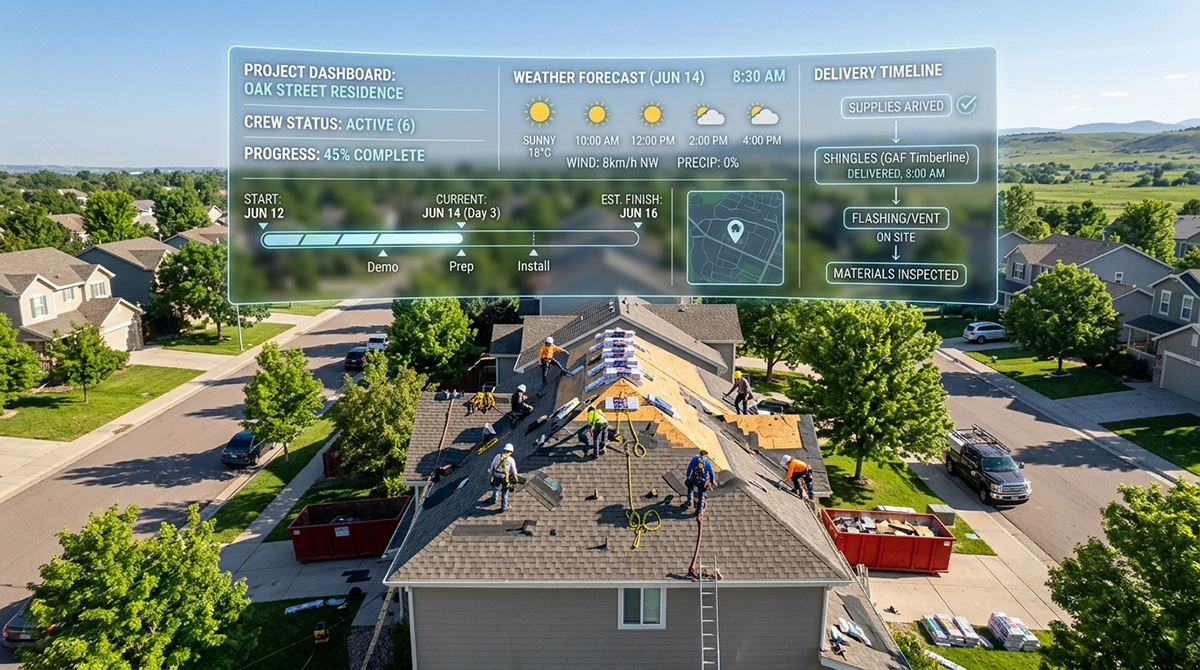
The roofing industry is experiencing a significant transformation as artificial intelligence moves from futuristic concept to practical reality. Smart contractors are now using AI-powered tools to tackle three of their biggest challenges: keeping projects on schedule, managing materials efficiently, and dealing with unpredictable weather. These technologies aren’t just making roofing projects faster, they’re making them safer, more profitable, and less stressful for everyone involved.
Research shows that weather delays impact 45% of construction projects worldwide each year, costing billions in additional expenses and lost revenue. Meanwhile, traditional project management methods struggle with labor shortages and tight timelines, with only about 35% of business projects reaching successful completion. AI is changing these statistics by bringing predictive intelligence, real-time monitoring, and automated adjustments to roofing operations.
How AI Optimizes Project Timelines
Traditional roofing schedules often rely on spreadsheets, whiteboards, and educated guesses about how long jobs will take. This approach leaves contractors vulnerable to delays, inefficient crew utilization, and frustrated customers. AI-powered project management tools are replacing this guesswork with data-driven precision.
Smart Scheduling Based on Multiple Variables
Modern AI scheduling platforms analyze crew availability, location proximity, real-time weather forecasts, and material delivery times to build optimized daily schedules. When unexpected changes occur, like a thunderstorm appearing on the radar or a delivery delay, the system automatically adjusts the calendar and sends updates to homeowners and crew members.
This intelligent scheduling addresses several common problems simultaneously. Crews spend more time working on roofs and less time stuck in traffic or waiting on supplies. Fuel costs decrease as AI optimizes routing to reduce drive times between jobs. Most importantly, customers appreciate accurate arrival windows and quick weather reschedules, leading to fewer angry calls about late arrivals or no-shows.
By 2030, experts predict that approximately 80% of today’s project management functions will be run by AI, reflecting the technology’s growing importance in construction operations. AI scheduling systems have already demonstrated the ability to reduce project delays by up to 20%, improving delivery timelines across enterprise construction projects.
Predictive Analytics for Timeline Accuracy
AI leverages historical data and complex algorithms to predict project timelines with remarkable accuracy. By analyzing patterns from previous roofing projects, weather conditions, material availability, and crew performance, machine learning systems can forecast potential delays before they happen.
For roofing contractors, this means more accurate quotes and better crew planning. If data shows that flat roof repairs typically run 20% longer than expected, AI systems can adjust estimates, crew assignments, and scheduling in advance to avoid frustrated customers and missed deadlines. This predictive capability helps contractors set achievable deadlines and organize resources appropriately from the project’s outset.
The technology also identifies risks early by evaluating past projects and pinpointing recurring challenges, allowing managers to implement preventive measures. One roofing industry executive noted that predictive insights enable teams to “analyze their project data like never before,” producing metrics and key performance indicators for evaluating project success rather than relying primarily on end-of-project margins.
Real-Time Monitoring and Adaptive Adjustments
AI systems continuously monitor changing conditions throughout the roofing project lifecycle. Construction schedulers receive real-time updates for dangerous weather, notifications when it’s safe to resume outdoor work, and alerts about how changing conditions might affect critical path tasks.
This real-time monitoring creates what experts call “dynamic schedules” rather than static timelines. When unexpected obstacles arise, whether weather-related, supply chain disruptions, or on-site complications, AI algorithms immediately reorganize tasks to minimize disruptions. The system identifies optimal windows for weather-sensitive work and reallocates resources based on forecasted conditions.
Machine learning algorithms can also optimize resource allocation by analyzing project timelines and establishing optimal schedules based on past performance and ongoing trends. These algorithms consider external factors to create more realistic and adaptive project timelines, freeing human schedulers to focus on higher-level decisions while reducing manual work and creating safer, more efficient construction projects.
AI-Driven Material Management
Material shortages, overstocking, and poor inventory tracking have long plagued roofing contractors, causing project delays and eating into profit margins. AI is revolutionizing how contractors manage supplies, transforming material management from a source of headaches into a competitive advantage.
Real-Time Inventory Tracking
Traditional construction inventory management relies on manual updates and periodic checks, which can lead to situations where materials run out unexpectedly, causing costly delays. AI-powered inventory management tools enable real-time stock monitoring through connected sensors and automated data collection, providing a constant stream of information on material usage and stock levels across job sites, warehouses, and service trucks.
Smart inventory systems keep track of stock levels, send low inventory alerts, and automate reordering to ensure required materials are available where and when needed. For example, contractors receive immediate alerts when shingle supplies dip below a critical threshold, allowing them to place orders and receive new roofing materials before current stock runs out.
Field technicians can quickly scan materials in and out using mobile devices with barcodes, QR codes, or NFC tags. Every material transaction, whether at a job site, warehouse, or in transit, updates inventory in the central database in real time, ensuring accurate stock records. If required supplies aren’t available at the job site, a technician can quickly check inventory across all locations using the mobile app and retrieve what they need from the nearest available source, reducing extra trips and unnecessary orders.
Predictive Ordering and Just-In-Time Delivery
AI facilitates cost-saving practices like just-in-time ordering by monitoring material usage and calculating when additional stock is needed. The system finds the correct resupply amount and determines shipping times necessary for materials to arrive on the job site precisely when needed. This strategy eliminates surplus and waste at the end of projects while ensuring contractors only pay for what they actually use.
AI-driven real-time stock tracking helps roofing companies manage inventory effectively by analyzing large data volumes and predicting needs, which reduces the risk of shortages or overstocking. Automated reordering simplifies procurement, allowing contractors to prioritize customer satisfaction without constant inventory concerns.
By leveraging advanced data analytics, companies can optimize storage layouts, reducing excess inventory and improving space utilization. Machine learning algorithms enhance this further by predicting material usage based on client preferences and historical consumption patterns.
Supply Chain Optimization
AI addresses challenges in traditional roofing material supply chains, which often suffer from poor communication with suppliers and inventory management issues that disrupt project timelines. These problems become particularly acute during periods of high demand when many contractors need supplies simultaneously.
AI enhances demand forecasting and supplier communication by analyzing past trends and providing proactive updates. Smart tools enable better collaboration with suppliers, helping contractors achieve their roofing objectives smoothly. The technology can predict supply delays and suggest backup vendors, ensuring projects continue even when primary suppliers face challenges.
Some AI platforms have added features that automatically adjust schedules if delivery issues arise, maximizing crew productivity and reducing delays. This integration of material tracking with project scheduling creates a seamless workflow where material availability directly influences task sequencing and crew assignments.
Weather Forecasting and Risk Management
Weather remains one of the most unpredictable and costly factors affecting roofing projects. While contractors have always checked weather forecasts, AI is taking weather intelligence to an entirely new level through hyperlocal predictions, historical data analysis, and automated schedule adjustments.
Hyperlocal Weather Predictions
Traditional weather forecasts provide regional information that often varies significantly even across short distances, a critical limitation for construction projects. AI-powered weather forecasting delivers predictions specific to individual construction sites through sophisticated machine learning algorithms and real-time weather data synthesis.
Advanced weather AI models like Google DeepMind’s GraphCast can predict weather conditions up to 10 days in advance more accurately than industry gold-standard weather simulation systems. Newer systems like Aardvark Weather deliver accurate forecasts faster and with less computing power than existing methods. These AI models generate ensemble forecasts, providing a more probabilistic approach to predicting weather scenarios that helps contractors understand the range of possible outcomes.
Weather AI processes comprehensive data from multiple sources including historical records, real-time satellite imagery, on-site IoT sensors, and project-specific scheduling information. This holistic approach creates a more complete picture than any single data source, with precision critical since weather conditions can vary significantly even across short distances.
For roofing contractors, this means scheduling jobs based on actual conditions at their specific work site rather than general area forecasts. AI planners mix crew skills, local traffic patterns, weather forecasts, and material drop times to build the best job schedule for each day.
Predictive Maintenance Through Weather Data
AI algorithms can analyze historical weather data, material performance, and roof characteristics to predict potential issues before they escalate. This predictive maintenance approach allows contractors to identify vulnerabilities, pinpointing areas of roofs more susceptible to damage based on environmental factors.
By combining roof age, local storm history, and previous repair data, AI systems can estimate when roofs are likely to leak and send reminders or auto-generate service plan offers before problems start. Rather than waiting for emergency leaks, contractors can establish recurring revenue through check-ups and minor repairs, keeping crews busy in slow seasons while building customer loyalty.
AI-driven predictive maintenance helps homeowners maximize roof lifespans by addressing issues early. For roofing contractors, this capability transforms their business model from reactive repairs to proactive service plans, creating more stable revenue streams and stronger customer relationships.
Automated Schedule Adjustments for Weather Events
When weather conditions change, AI systems update construction schedules automatically by identifying optimal windows for weather-sensitive work, reorganizing tasks to minimize disruptions, and reallocating resources based on forecasted conditions. This capability is particularly valuable for roofing, where work often cannot proceed safely during rain, high winds, or extreme temperatures.
Supervisors can use AI to write effective weather-related messages quickly, such as telling workers to start waterproofing because the latest radar update shows a rain cloud unexpectedly heading their way. The AI can also instantly translate messages so individual employees receive important notifications in their preferred language.
Some software platforms automatically adjust schedules if weather changes, maximizing crew productivity and ensuring better crew utilization with fewer delays and happier customers. These automated adjustments prevent the common scenario where crews arrive at job sites only to discover conditions aren’t suitable for roofing work, wasting time and money on unproductive travel.
Climate-specific forecasting companies like ClimateAi have successfully predicted substantially elevated risks of hurricane impacts well before storms became active, allowing roofing material manufacturers and contractors to adjust tactical decisions and prepare for increased demand. Their platform predicted 30-50% higher risk than normal in Florida before Hurricane Ian, demonstrating how AI-translated hurricane risk into probabilistic insights meaningful for business decisions.
Real-World Benefits and ROI
The integration of AI into roofing project planning delivers measurable returns across multiple dimensions: cost savings, time efficiency, improved safety, and enhanced customer satisfaction.
Cost Savings and Efficiency Gains
AI-powered tools have helped construction firms cut operational costs significantly. By automating labor-intensive tasks and optimizing workflows, AI-driven robotics and scheduling systems have helped firms cut operational labor costs by up to 25% while maintaining build quality and accelerating timelines.
A 2025 Houzz report found that AI can save construction professionals approximately $170,000 annually through improved efficiency and reduced waste. Companies investing in AI are reporting average returns of 3.5 times their investment, with some organizations seeing returns as high as 100% ROI, meaning for every dollar invested, they receive benefits of two to three dollars per year.
For roofing contractors specifically, AI reduces costs through lower fuel bills via optimized routing, higher crew productivity through better scheduling, and fewer wasted materials through accurate quantity predictions. Automated cost estimation eliminates hours of manual calculations while improving accuracy, helping contractors avoid underbidding or overpricing projects.
Time Savings and Project Acceleration
AI scheduling systems have reduced project delays by up to 20%, improving delivery timelines across enterprise construction projects. Enterprises that shifted from manual workflows to AI-powered construction planning saw up to 30% fewer project overruns and significantly reduced coordination errors.
For daily operations, AI-powered tools generate accurate estimates in minutes rather than hours, allowing contractors to respond to customer inquiries faster and close more deals. Roof inspections that once took hours can now be completed through AI-assisted drone technology in a fraction of the time, allowing contractors to take on more projects.
The efficiency gained translates directly into shorter project timelines and faster turnarounds. By analyzing multiple variables, such as weather forecasts, material availability, and crew schedules, AI ensures projects proceed smoothly and on time.
Enhanced Safety
AI enhances safety measures within roofing and construction sites in multiple ways. Robust technologies can predict wind hazard updates for crane operations or offer valuable input regarding best timeframes for concrete or material application, contributing to overall productivity and risk reduction.
AI systems monitor worker behavior and site conditions to prevent accidents. Predictive capabilities ensure the longevity of equipment and structures by processing sensor data through AI algorithms. Drones equipped with AI eliminate the need for manual roof inspections that expose workers to fall risks, with 50% of construction workers reporting exposure to dangerous work environments where drones could potentially reduce injury risk.
By keeping teams safely on the ground while still gathering necessary inspection data, IoT and AI foster a much safer working environment and provide stronger liability protection.
Improved Customer Experience
AI enhances how roofing companies interact with customers throughout the project lifecycle. Virtual assistants and chatbots handle incoming inquiries, qualify leads, schedule appointments, and answer frequently asked questions 24/7, meeting modern homeowner expectations for fast, digital-first communication.
AI tools analyze customer feedback, detect issues in call transcripts, and alert managers to potential problems before they escalate, enabling a proactive approach to follow-up and service recovery. This creates a smoother, more satisfying customer journey that leads to more five-star reviews and referrals.
Contractors can provide customers with accurate arrival windows and quick weather reschedules, significantly reducing complaints about late arrivals. Modern homeowners expect transparency and efficiency, and drones combined with AI-generated reports present clear, easy-to-understand insights about roof conditions, building trust with clients.
Practical AI Tools for Roofing Contractors
The roofing industry now has access to numerous AI-powered platforms designed specifically for their needs. Leading solutions include:
Comprehensive Management Platforms like AccuLynx, which centralizes sales, production, and financial management with AI-driven tools for lead management, accurate roof measurement, and automated workflow. JobNimbus provides AI-assisted project management with data analysis and predictive recommendations. ServiceTitan offers AI-powered roofing estimates using Pricebook Pro with real-time labor and material cost updates.
Measurement and Inspection Tools such as iRoofing, which features an AI-powered roof visualizer that allows realistic simulations of how different materials will look on specific roofs. RoofSnap leverages high-definition aerial imagery to deliver precise roof measurements, eliminating manual site visits. Nearmap provides AI-driven analysis of high-resolution aerial imagery to identify aging roofs, climate vulnerabilities, and properties needing attention.
Weather and Predictive Analytics platforms including Tomorrow.io’s AI-backed weather intelligence, which utilizes sophisticated machine learning algorithms for hyperlocal near-real-time weather forecasts specifically designed for construction. ClimateAi’s ClimateLens platform translates hurricane and storm risk into probabilistic insights meaningful for roofing demand planning.
These tools integrate with existing business systems and each other, creating comprehensive ecosystems that handle everything from initial lead generation through final invoicing. Many offer mobile apps that allow field teams to access AI capabilities on-site, ensuring technology benefits reach beyond the office.
Looking Ahead: The Future of AI in Roofing
The roofing industry stands at a turning point where AI adoption is shifting from competitive advantage to business necessity. Companies embracing these technologies now are positioning themselves to handle future challenges including ongoing labor shortages (with 41% of the current construction workforce expected to retire by 2031) and increasing project complexity.
Gartner predicts that by 2030, approximately 80% of today’s project management functions will be run by AI, fundamentally changing how roofing projects are planned and executed. The construction industry is moving toward proactive AI decision-making versus reactive old-school approaches, with tools that analyze project risks based on outstanding tasks and produce metrics for evaluating success in real-time rather than after project completion.
Emerging technologies include agentic AI that can autonomously make decisions and adjustments throughout project lifecycles, more sophisticated IoT sensor integration for continuous roof monitoring during and after installation, and enhanced machine learning models that improve accuracy with each completed project.
For roofing contractors evaluating whether to adopt AI, the question is no longer “if” but “when” and “how.” The technology is here, proven, and delivering measurable results. Starting with focused applications, such as AI-powered scheduling, weather forecasting, or material tracking, allows contractors to gain experience and demonstrate value before expanding to comprehensive AI-enabled business models.
The companies that integrate AI thoughtfully into their operations today will be the industry leaders tomorrow, delivering better projects, safer work environments, and more satisfied customers while maintaining healthy profit margins in an increasingly competitive market.
Ready to schedule your inspection? Call Roof Panther today at (217) 530-8570.