
The Exterior Package for Your New Home

Building a new home in Champaign County means making a lot of decisions at once, and the exterior trades are among the most consequential. Roofing, siding, windows, gutters, and outdoor living spaces all need to work together as an integrated system. When they’re specified and installed by separate contractors who never talk to each other, the gaps between systems are where problems develop: water intrusion at window-to-siding transitions, gutter placement that fights the fascia profile, deck ledger attachments that compromise the siding moisture barrier.

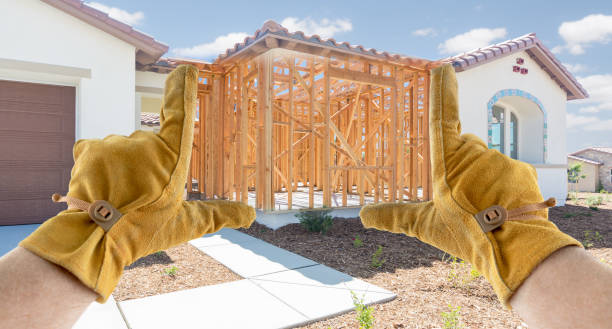
Male Contractor Hands Framing Unfinished Section of House.

Roof Panther handles the complete exterior package for new construction projects throughout Central Illinois. That means one contractor, one point of contact, and coordinated installation from roofing through gutters through outdoor living. This page explains what that scope looks like and how we work with homeowners and builders.

Who This Page Is For

It helps to be specific about the types of new construction projects we work on, because “new construction” covers a wide range.


Owner-builders who are managing their own build and need to source exterior trades directly. We work with you the same way we’d work with any general contractor, showing up on schedule, coordinating with the other trades on site, and delivering a complete exterior that doesn’t create problems for the interior finishers who follow.

Custom home builders who need a reliable exterior subcontractor they can count on for scheduling and quality across multiple projects. We work with several builders in the Champaign-Urbana area on an ongoing basis.

Homeowners building through a general contractor who want to understand what the exterior package should include and how to evaluate whether their builder is specifying it correctly. Even if we’re not doing the work, understanding what good looks like helps you ask the right questions.


What we don’t do is general contracting for full home builds. We’re specialists in the exterior, from the roof deck down to the outdoor living spaces, not the framing, foundation, or interior systems.


Why the Exterior Trades Need to Be Coordinated

Each component of a home’s exterior affects the others in ways that aren’t always obvious until something fails.

Roof overhangs determine how much weather protection the siding below gets. A roof designed without input from the siding contractor may produce overhang dimensions that leave the top course of siding more exposed than it should be.

Window flashing integrates with the house wrap and siding installation sequence. If windows are installed before house wrap, or if the flashing sequence doesn’t account for how the siding will lap, you get a detail that looks fine for a few years and then starts leaking.

Deck ledger attachments penetrate the siding and house wrap. If the ledger isn’t flashed and sealed correctly where it meets the wall assembly, that penetration becomes a long-term water intrusion point. We’ve repaired enough of these on existing homes to take ledger flashing seriously on every new build.

Gutter placement depends on fascia dimensions and the roof edge profile. Gutters sized and placed without reference to the actual roofline and fascia depth don’t drain properly and often pull away from the fascia prematurely.

When one contractor handles all of these trades, the coordination happens internally rather than falling through the cracks between separate subcontractors.

Roofing for New Construction

The roofing scope on a new build is different from a reroof in a few important ways. The roof deck, ventilation system, and underlayment all go in during framing and sheathing, before the finished roofing material is installed. Getting these components right matters more than the shingle brand the homeowner picks.


Roof deck preparation starts with the sheathing. H-clip spacing between panels, proper nailing patterns, and a clean flat deck surface all affect how the finished roofing material performs and how long it lasts.

Ventilation is one of the most consistently underspecified systems in residential new construction. Inadequate attic ventilation leads to moisture buildup in winter and excessive heat in summer, both of which shorten shingle life significantly. Central Illinois summers are hot enough that attic temperatures in a poorly ventilated space can exceed 150 degrees, which degrades asphalt shingles from above while the sun degrades them from below. We specify intake and exhaust ventilation based on the actual attic square footage, not the minimum that passes inspection.

Ice and water shield belongs at every eave, valley, and penetration in a Central Illinois climate. Some builders treat it as an upgrade rather than a baseline. We don’t. Freeze-thaw conditions in this region make ice dam protection at the eave line a standard installation practice, not an optional one.

Underlayment throughout the field of the roof provides a secondary drainage plane if the primary roofing material is ever compromised. Synthetic underlayments outperform felt in both durability and moisture resistance, and that’s what we use as standard.


For specific roofing material options, shingle types, and what goes into a complete residential roof system, see our residential roofing page.

Siding for New Construction

Siding selection for a new home is a long-term decision. The material you install at the beginning of a home’s life is what you’ll be living with for 20 to 40 years. Getting it right the first time is considerably cheaper than replacing it.

The most common siding materials we install on new construction in Central Illinois are fiber cement, engineered wood, and vinyl. Each has genuine strengths and real tradeoffs.

Fiber cement

Primarily James Hardie products, is the premium choice for homeowners who want wood appearance with minimal maintenance and maximum durability. It's dimensionally stable through our temperature swings, fire resistant, and holds paint well. The installation requirement is more exacting than vinyl, which is where quality of the installer matters

Engineered wood

Particularly LP SmartSide, offers a wood-grain aesthetic at a lower price point than fiber cement with better moisture resistance than real wood. It's a strong choice for homeowners who want the look of wood without the maintenance commitment

Vinyl

Has improved significantly in the past decade. Modern vinyl with insulated backing performs well thermally and holds up through freeze-thaw conditions. It's the most cost-effective option and requires the least maintenance of the three

Whatever material is chosen, installation quality determines longevity. House wrap lapped and taped correctly, flashing integrated at every penetration, and siding installed with the right spacing for expansion and contraction are what make a siding installation last. These are details that don’t show up in photos but determine whether the system performs in year fifteen the way it did in year one.


For the complete breakdown of siding materials, profiles, and what drives the cost differences, see our siding page.

Windows for New Construction

Window selection in a new build is where many homeowners get overwhelmed by options and end up defaulting to whatever the builder specifies at the base price. That default choice is frequently the minimum that passes energy code, which in Illinois means double-pane with basic Low-E coating. It meets code. It’s not necessarily the best value over the life of the home.

The decisions that matter most are glazing performance and frame material. For Central Illinois, windows with high solar gain Low-E on south-facing exposures and moderate solar gain Low-E on east, west, and north exposures optimize for our heating-dominated climate. Argon fill between panes is standard in any quality window and worth insisting on. Frame material affects both thermal performance and long-term maintenance: fiberglass frames outperform vinyl in dimensional stability and longevity, at a higher upfront cost.

Installation sequence on new construction matters as much as the window itself. Windows installed before house wrap, or without proper head and sill flashing, will eventually admit water regardless of the window quality. We install windows as part of the wall assembly sequence, not as an afterthought.

For the full breakdown of window types, frame materials, and glazing options, see our windows page.

Gutters for New Construction

Gutters on a new home are sized and placed based on the actual roof drainage areas, which are determined by the final roof design. This is information that isn’t available until the roofline is established, which is why gutter specification should happen late in the design process rather than early.

The standard for new construction gutters in this area is seamless aluminum. We fabricate gutters on-site to the exact lengths required, eliminating the joints that become leak points in sectional systems. Downspout count and placement is determined by drainage area calculations, not by what looks symmetrical from the street.

One detail worth specifying during the build rather than addressing later: downspout discharge. A downspout that terminates at grade against the foundation accomplishes very little. Underground drainage routed to daylight or a dry well, or at minimum extended splash blocks that direct water well away from the foundation, should be part of the original gutter specification.

For the full overview of gutter materials, sizing, and what proper installation involves, see our gutters page.

Outdoor Living on a New Build

This is the area where planning during construction produces the most outsized return on a small investment of thought. Adding a deck, patio, or pergola after a home is complete is always more expensive and more disruptive than planning for it from the start, because the infrastructure decisions that support outdoor living need to be made while walls are open and concrete is being poured.


Deck attachment points. If you know you’ll want a deck, the ledger attachment location should be planned into the framing and the house wrap and siding installation sequenced around it. A ledger added to a fully finished wall requires cutting through siding and house wrap, which creates a flashing challenge that’s harder to solve cleanly.

Patio drainage. If the grade behind the house will support a patio, the finish grade and any underground drainage can be established during site work rather than after landscaping is done.

Gas and electrical rough-ins. Running a gas line for an outdoor grill or fire feature, and conduit for outdoor lighting and outlets, costs a fraction as much during construction as it does after the exterior is finished. These are the decisions that are cheapest to make before the walls are closed.


For the full breakdown of what goes into patios, decks, and pergolas, see our patios page, deck builder page, and pergolas page.

How We Work on New Construction Projects

Our involvement on a new build typically starts during the design phase rather than at the point when contractors are being scheduled. Getting involved early lets us review plans for details that affect exterior performance, flag anything that will create coordination problems between trades, and give the builder or homeowner accurate material and labor costs before those numbers are locked into a budget.

During construction, we work within the project schedule and coordinate with the other trades on site. The sequencing of exterior trades matters: roofing before siding, siding before windows in some configurations, gutters last. We know the sequence and we show up when we’re supposed to.

After installation, we provide documentation for all materials and systems, register manufacturer warranties where applicable, and do a final walkthrough with the homeowner or builder before closing out the project.

Building in the Champaign-Urbana Area

The Champaign-Urbana market has seen consistent new residential construction in areas including southwest Champaign, Savoy, Mahomet, and St. Joseph over the past several years. We work throughout this area and are familiar with the local building department processes and inspection requirements.

Central Illinois presents specific exterior performance demands: hot humid summers, cold winters, significant wind exposure from flat open terrain, and the freeze-thaw cycles that affect every material decision from footing depth to siding installation practice. Contractors who build in coastal or southern markets and periodically take work in this region don’t always account for these conditions. We do.

Ready to Talk Through Your Project?

Whether you’re an owner-builder sourcing your own trades, a builder looking for a reliable exterior subcontractor, or a homeowner trying to understand what your builder’s exterior package should include, contact Roof Panther for a consultation. We’re straightforward about scope, honest about cost, and familiar with what it takes to build a home that performs well in Central Illinois for the long term.

Our Credentials

Licensed

In Illinois (#104.018415) and growing

Bonded

For your peace of mind

Insured

With high limits

Guaranteed

With a workmanship warranty

Contact Us! (Please provide your contact information below.)

We Look Forward To Working With You!

Roof Panther

903 N High Cross Rd. Urbana, IL 61802

By Appointment Only

Phone

(217) 530-8570

Email

roofpanther@gmail.com

Follow Us