
Illinois does not make life easy on a roof. In the same year, a roof might bake under 95-degree summer sun, take a direct hit from a hailstorm, hold three feet of snow, and crack apart in a January freeze-thaw cycle. Champaign County sits right in the path of all of it.
Most roof failures do not start as one dramatic event. They start small, get ignored, and grow into something expensive. As a roofing company in Champaign, we’ve walked enough roofs after the fact to know the pattern. Here are 15 of the most common roofing problems we see across Champaign, Urbana, and the surrounding communities, grouped by what usually causes them.
Wind Damage
1. Lifted or Missing Shingles
Illinois wind does not need to be a named storm to do damage. A sustained gust can catch the edge of an asphalt shingle, break its seal, and either lift it or tear it off completely. Once one shingle is gone, the ones around it lose part of their protection too, and the next windy day tends to take a few more.
2. Creased Shingles
Wind can fold a shingle back on itself without removing it. The shingle may look intact from the ground, but a crease breaks the seal strip and the mat underneath, which weakens that spot permanently even after it lies back down flat.
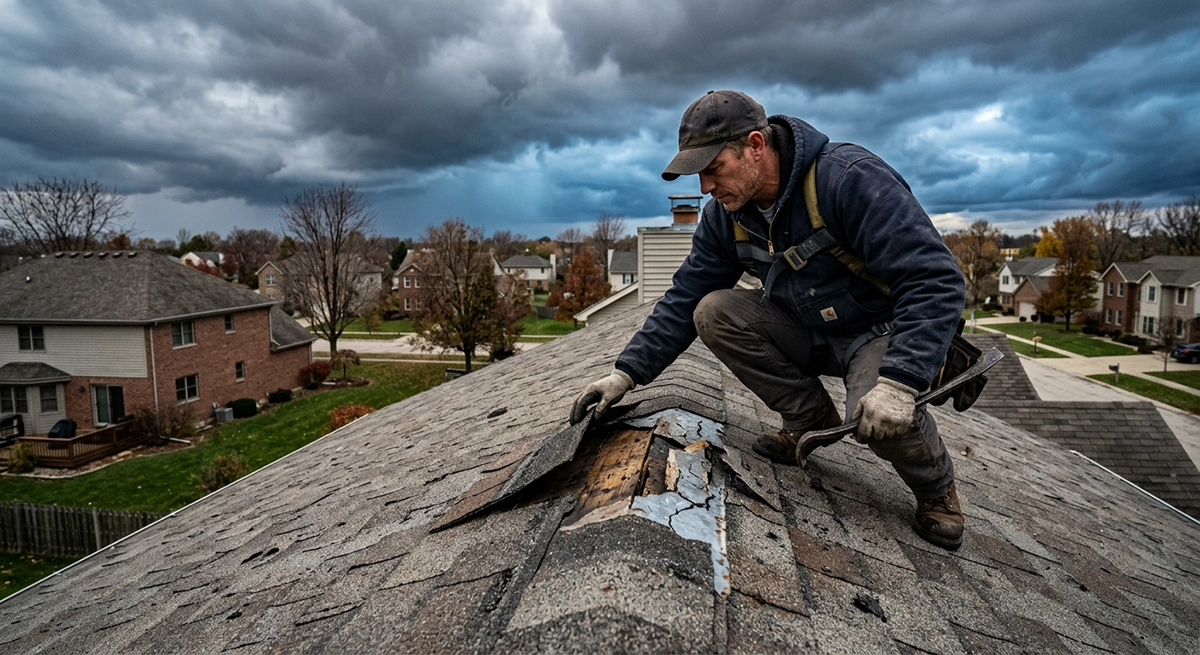
3. Loosened Ridge Caps
Ridge cap shingles cover the peak of the roof and take the brunt of wind coming from any direction. They are smaller and more exposed than field shingles, so they tend to lift and fail before the rest of the roof shows any wear.
Hail Damage
4. Shingle Bruising
Hail does not always punch a hole through a roof. More often it bruises the shingle, knocking loose the protective granules and cracking the mat underneath without breaking through completely. A bruised shingle can look fine in a drive-by inspection and still fail early because the impact point has lost its waterproofing.
5. Granule Loss
Every shingle relies on its granule layer to block UV rays and shed water. Hail, heavy rain, and age all wear granules away. Once you’re finding a heavy pile of them at the bottom of a downspout, the shingles underneath have lost a real layer of protection, not just a cosmetic one.
6. Damaged Soft Metal
Gutters, flashing, vent caps, and window screens are softer than shingles and show hail impacts more clearly. If those show dents after a storm, it’s worth having the roof checked too, even if the shingles look okay from the ground.
Ice Dams and Snow Load
7. Ice Dams at the Eaves
When heat escapes from the attic and melts snow on the upper roof, that water runs down and refreezes at the colder eaves. The resulting ice dam blocks proper drainage and can force water back up under the shingles, right into the house. This is one of the most common cold-weather leak sources in Central Illinois.
8. Snow Load Stress
A few inches of snow rarely bothers a roof, but wet, heavy snow that piles up over several storms adds real weight. Older roofs, roofs with a history of sagging, or roofs already weakened by rot can be pushed past what they were built to carry.
9. Freeze-Thaw Cracking
Water that gets into a crack, seam, or gap and then freezes will expand and widen that opening. It thaws, lets in more water, and freezes again. Illinois winters run through this cycle over and over, which is why small imperfections that would sit harmlessly in a milder climate turn into real leaks here.
Leak-Prone Details
10. Cracked or Failing Flashing
Flashing seals the transitions where a roof meets a chimney, wall, skylight, or valley, which are exactly the spots too irregular for shingles alone to cover. Metal flashing corrodes, sealant dries out and cracks, and improperly installed flashing fails early. These joints are one of the top leak sources on any roof.
11. Deteriorated Pipe Boots
The rubber or plastic boot around a plumbing vent pipe hardens and cracks with age and sun exposure well before the shingles around it wear out. Because the opening surrounds a pipe running straight into the attic, a failed boot lets water in fast.
12. Chimney and Skylight Leaks
Chimneys and skylights each bring their own leak risks: masonry that lets water through mortar joints, counter-flashing that pulls away from brick, or skylight seals that age out. These features interrupt the roof’s surface, so they need their own attention during an inspection, not just a glance from the ground.
13. Worn Valleys
Valleys are the low points where two roof slopes meet, and they carry more water than any other part of the roof. That extra volume means valley materials wear out faster than the field shingles around them, often years before the rest of the roof needs attention.
General Wear and Neglect
14. Poor Attic Ventilation
A roof needs the attic beneath it to breathe. Without enough intake and exhaust airflow, heat and moisture build up, which cooks shingles from underneath in summer and encourages condensation and mold in winter. Ventilation problems shorten a roof’s life even when the shingles themselves are in decent shape.
15. Clogged Gutters and Poor Drainage
Gutters packed with leaves and shingle granules stop moving water away from the roof edge. That backup can work its way under the shingles at the eaves, contribute to ice dam formation in winter, and send water down the siding and toward the foundation instead of away from the house.
Why These Add Up Fast in Illinois
Most of these problems are manageable on their own. What makes Illinois roofs vulnerable is how many of them stack in a single year. A roof that takes hail damage in spring, bakes through a humid summer, and then goes through a dozen freeze-thaw cycles in winter is under more stress than a roof in a milder, more consistent climate ever sees.
That is also why a roof that “looks fine” from the driveway can still be failing. Bruised shingles, cracked flashing, and worn valleys are rarely visible from the ground. They show up on a physical inspection, on the roof, not from a truck parked at the curb.
Signs It’s Time for a Closer Look
- Shingle granules collecting near downspouts
- Missing, curled, cracked, or lifted shingles
- Visible sagging anywhere on the roofline
- Rust, gaps, or loose sections in flashing
- Ice buildup along the eaves in winter
- Daylight in the attic where there shouldn’t be any
- A ceiling stain that appears after a storm
- Gutters pulling away from the fascia
None of these guarantee a major problem, but any of them is a reason to have someone take a real look before the next storm or the next thaw.
Schedule a Roof Inspection in Champaign
Roof Panther inspects roofs across Champaign, Urbana, Savoy, Mahomet, St. Joseph, Rantoul, Danville, and the rest of Central Illinois. We check the shingles, flashing, valleys, ventilation, and drainage, document what we find, and tell you honestly whether the roof needs a repair, a replacement, or nothing at all.
Call (217) 530-8570 to schedule an assessment.
Roof Panther is a family-owned roofing contractor in Champaign, licensed in Illinois (#104.018415), bonded, and insured.