

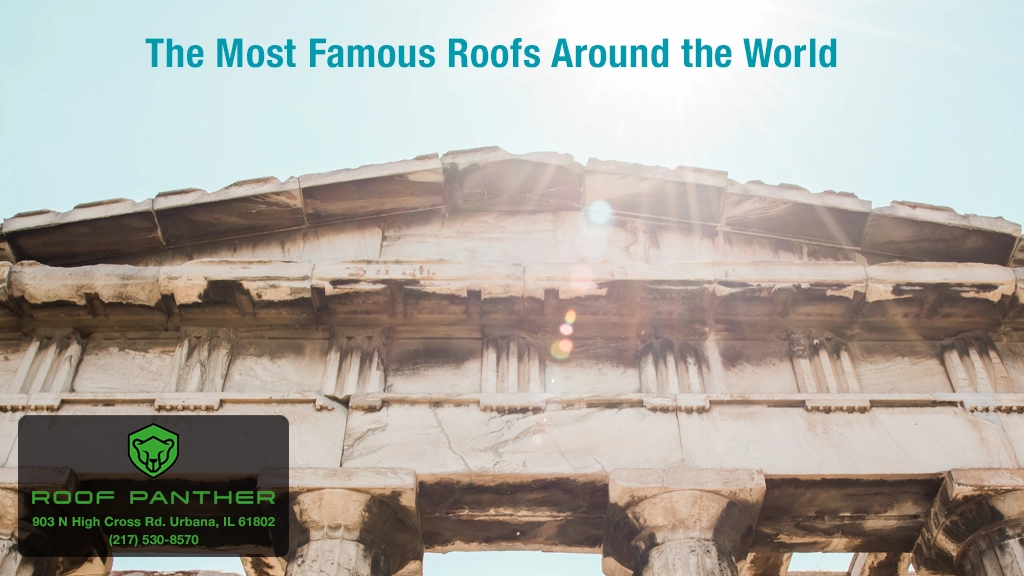
When you think of iconic landmarks, it’s often the roof that leaves the most lasting impression. From gleaming domes to colorful tiles, these architectural crowns don’t just protect buildings from the elements. They tell stories, represent cultures, and push the boundaries of engineering. Join us on a journey across continents to explore the world’s most spectacular rooftops that have captivated millions of visitors and inspired architects for generations.
Sydney Opera House – The Sailing Masterpiece of Australia
Sydney Opera House
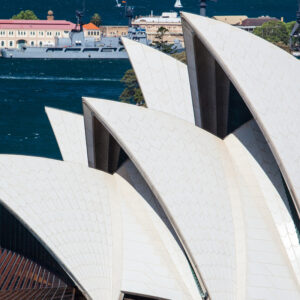
Perhaps no roof in the world is more instantly recognizable than the Sydney Opera House. Sitting majestically on Bennelong Point, this architectural icon was designed by Danish architect Jørn Utzon after winning an international design competition against 233 other submissions in the late 1950s.
Construction commenced in 1959 and took an ambitious 14 years to complete, involving 10,000 construction workers. The result was worth every moment of effort. The distinctive “shells” or “sails” that define the building’s profile are actually precast concrete panels covered by over 1,056,000 glazed-white granite roof tiles imported from Sweden, covering approximately 1.62 hectares.
Each tile was individually hand-glazed in white, blue, and green, then shipped halfway around the world for assembly. The roof is considered one of the engineering wonders of the modern world, and its unique design has made the Sydney Opera House one of the most photographed buildings globally.
Saint Basil’s Cathedral – Moscow’s Colorful Fantasy
Saint Basil’s Cathedral
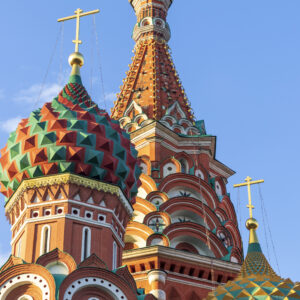
Standing proudly in Moscow’s Red Square, Saint Basil’s Cathedral features one of the most visually striking roofscapes in Russian architecture. Built in the mid-16th century during the reign of Tsar Ivan IV (Ivan the Terrible), the cathedral was constructed to commemorate the defeat of Kazan, the final hold that the Mongolian Empire had over Russia.
The 156-foot-high central church is surrounded by eight smaller chapels, designed to resemble an eight-pointed star, with a ninth chapel added later over the tomb of St. Basil. What makes the roof truly unforgettable is its vibrant color scheme.
Originally, the cathedral’s domes were gold and the building itself was white, matching the white stone of the Kremlin. But 200 years later, the domes and façade were painted in the iconic swirling colors we recognize today.
These onion-shaped domes with their intricate patterns and brilliant hues have become as synonymous with Russia as the Eiffel Tower is to France.
The Taj Mahal – India’s Marble Crown of Love
The Taj Mahal
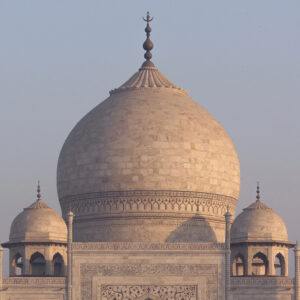
Recognized as one of the finest architectural jewels in the world for almost 400 years, the Taj Mahal stands as an eternal monument to love. Commissioned in 1632 by Mughal Emperor Shah Jahan in memory of his beloved wife Mumtaz Mahal, this white marble masterpiece took 20 years and 20,000 construction workers to complete.
The roof’s most distinctive feature is its iconic onion-shaped dome, made entirely from marble and measuring 26.5 meters high and 17.6 meters wide. The pristine white marble creates a breathtaking effect, changing color throughout the day. It appears pink at sunrise, dazzling white at midday, and golden during sunset.
The symmetrical design and perfect proportions of the dome have made it one of the most photographed roofs in history and a UNESCO World Heritage Site that attracts millions of visitors annually.
Chrysler Building – New York’s Art Deco Crown Jewel
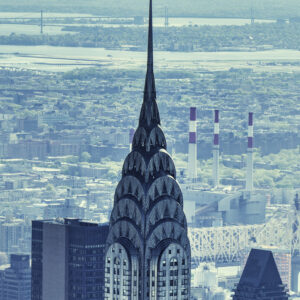
Chrysler Building
The Chrysler Building represents the pinnacle of Art Deco architecture in America. Completed in 1930, this Manhattan skyscraper was designed by architect William Van Alen for automotive executive Walter Chrysler during the height of New York’s “Race to the Sky.”
The building’s terraced crown is composed of seven radiating terraced arches in a cruciform groin vault design, all clad in gleaming Nirosta stainless steel. This was the first use of this “18-8 stainless steel” in an American project. The steel is ribbed and riveted in a radiating sunburst pattern with triangular vaulted windows, reminiscent of the spokes of a wheel.
The 185-foot spire was secretly constructed inside the building’s frame and assembled in just 90 minutes on October 23, 1929, dramatically pushing the building to its final height of 1,046 feet. Van Alen compared watching the spire’s installation to “watching a butterfly leaving its cocoon.”
The automotive-themed ornamentation throughout the building includes corner ornaments at the 31st floor modeled after 1929 Chrysler radiator caps and eagle gargoyles at the 61st floor.
Though the Chrysler Building held the title of world’s tallest for only 11 months before the Empire State Building surpassed it, its stunning Art Deco crown has made it one of the most beloved skyscrapers in the world.
Reichstag Dome – Berlin’s Symbol of Democracy
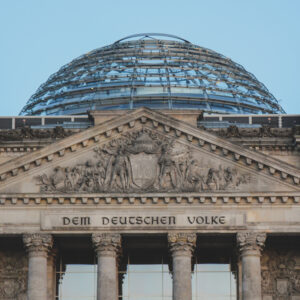
Reichstag Dome
The glass dome atop Berlin’s Reichstag building stands as a powerful symbol of Germany’s reunification and democratic future. Designed by renowned architect Sir Norman Foster and completed in 1999, this transparent structure was built to replace the original dome destroyed during World War II.
Made of 3,000 glass panels, the distinctive 360-degree dome allows visitors to look down into the parliamentary chamber below, literally placing citizens above their government. This is a deliberate statement about transparency and democracy. Two steel spiraling ramps reminiscent of a double helix wind upward, allowing visitors to walk to the top while enjoying panoramic views of Berlin.
The design is both symbolic and sustainable. A mirrored cone in the center directs natural sunlight into the debating chamber, significantly reducing artificial lighting needs and carbon emissions. A sun shield tracks the sun’s movement electronically, blocking direct rays that would cause glare.
Foster’s futuristic design was initially controversial but has become one of Berlin’s most important landmarks, representing Germany’s commitment to moving away from its dark past toward a transparent, united democratic future.
Sagrada Família – Gaudí’s Unfinished Masterpiece
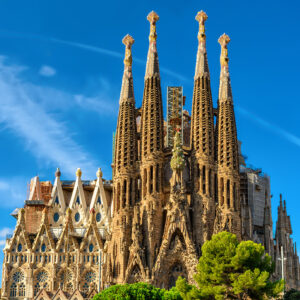
Sagrada Família
Antoni Gaudí’s magnum opus, the Sagrada Família in Barcelona, features one of the most ambitious roof designs ever conceived. Construction began in 1882, and though Gaudí dedicated 43 years of his life to the project, he knew he would never see it completed.
The original design calls for 18 spires representing biblical figures: 12 for the apostles, four for the evangelists, one for the Virgin Mary, and the tallest representing Jesus Christ. As of October 2025, the central Tower of Jesus Christ reached its final height of 172 meters, making the Sagrada Família officially the tallest church in the world, surpassing Germany’s Ulm Minster.
The spires are adorned with intricate sculptures, colorful mosaics, and symbolic elements. The Evangelists’ spires are topped with sculptures of their traditional symbols: a winged bull, winged man, eagle, and winged lion. The interior features tree-like columns that branch upward to support hyperboloid vaults reaching 75 meters at the apse.
Gaudí’s vision was to create a structure representing the endless variety and complexity of God’s creation, making it the most ambitious work of Christian architecture in the last century. The basilica is expected to be fully completed in 2026, marking the centenary of Gaudí’s death.
Casa Batlló – The Dragon’s Back in Barcelona
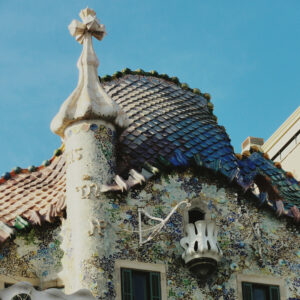
Casa Batlló
Another Antoni Gaudí masterpiece, Casa Batlló (also known as the House of Bones) features one of the most fantastical roofs in the world. This vibrant building in Barcelona was constructed in 1877 but completely reimagined by Gaudí in the early 1900s, eschewing typical architectural practices and pushing every boundary.
The colorful tiled roof is widely believed to represent the back of a dragon. The iridescent ceramic tiles serve as the dragon’s scales, shimmering in sunlight with blues, greens, and purples. A window represents the dragon’s eye, and the ridge of the roof forms the dragon’s spine.
The spire at the roof’s peak has sparked debate. Some interpret it as the dragon’s tail, while others believe it represents the mythical spear of Saint George, the patron saint of Gaudi’s hometown, who legendarily slew a dragon to save a princess.
The roof has been designated a UNESCO World Heritage Site and invites visitors to walk upon its colorful scales, dwelling in their own imagination as they experience Gaudí’s artistic vision.
Hospices de Beaune – France’s Medieval Gem
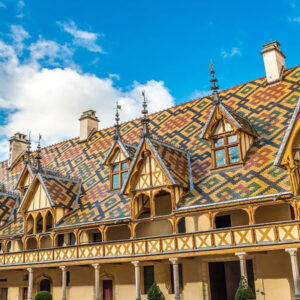
Hospices de Beaune
Located in the Burgundy region of France, the Hospices de Beaune features one of the most stunning roofs in medieval architecture. This 15th-century building originally served as a charity hospital for the poor and now operates as a hotel and museum.
The roof is famous for its carefully arranged glazed tiles in brown, red, yellow, and green that create striking geometric patterns among the building’s dormers and turrets. In medieval times, these glazed tiles were incredibly expensive and time-consuming to produce, making such a roof a powerful status symbol for French princes and wealthy city dwellers.
The region of Burgundy (Bourgogne) became renowned for this distinctive roofing style, and the Hospices de Beaune remains the most celebrated example. To continue the building’s charitable tradition, owners hold an annual charity wine auction at the property.
The Pantheon – Rome’s Ancient Engineering Marvel
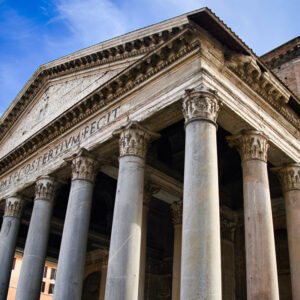
The Pantheon
Standing for nearly 2,000 years, the Pantheon in Rome features the world’s largest unreinforced concrete dome. It’s a testament to Roman engineering genius that modern architects still study today.
Built around 120 AD during Emperor Hadrian’s reign, the dome spans an impressive 43.3 meters (142 feet) in diameter, almost half the length of a football field. What makes this even more remarkable is that the height to the oculus (the opening at the dome’s peak) equals the diameter, meaning a perfect 43.3-meter sphere could fit within the interior.
Roman engineers achieved this engineering marvel through ingenious techniques. The concrete composition changes throughout the dome’s height, using progressively lighter materials. They started with brick and travertine at the base, then incorporated volcanic tuff and pumice stone higher up, and finally used small clay pots at the top. This reduced the dome’s weight from approximately 5.90 meters thick at the base to just 1.40 meters at the oculus.
The deep coffering visible from inside not only creates visual beauty but also significantly reduces the structure’s weight. Nearly two millennia later, the Pantheon remains the largest masonry dome ever constructed without reinforcement. No other ancient dome has survived without retrofitted support systems.
Grand Palace – Bangkok’s Royal Splendor
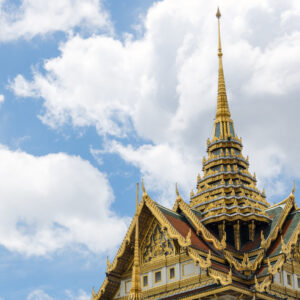
Grand Palace
The roof of Thailand’s Grand Palace represents a masterwork of traditional Thai architecture infused with cultural and religious symbolism. Located in Bangkok, the throne hall known as Phra Thinang Dusit Maha Prasat features elaborate multi-tiered roofs with sweeping curves, brilliant gold accents, and intricate ornamentation.
Every decorative element holds deep meaning related to Thai culture, history, and Buddhist beliefs. The complex rooflines feature chofa (sky tassels) at the corners, graceful finials that curve upward like birds taking flight. The layered roofs are covered in glazed tiles that shimmer in Thailand’s tropical sun, creating a dazzling visual spectacle.
The palace grounds span about 2.35 million square feet, and the roof systems throughout demonstrate the sophisticated craftsmanship and artistic vision of Thai builders. The Grand Palace remains one of the most visited tourist attractions in Southeast Asia, drawing millions of visitors who marvel at its ornate rooftops.
St. Stephen’s Cathedral – Vienna’s Colorful Marvel
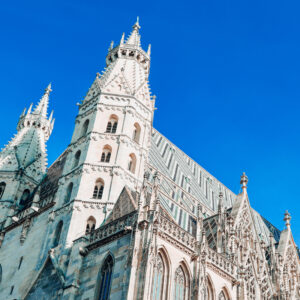
St Stephen’s Cathedral
The mother church of the Archdiocese of Vienna, St. Stephen’s Cathedral, features a roof dating back to the 14th century that remains one of Europe’s most distinctive. The steep roof is covered by 230,000 multicolored glazed tiles arranged in intricate patterns.
Beyond geometric designs, the tiles form recognizable images including coats of arms and a prominent two-headed eagle representing the Habsburg Empire. The roof’s steep pitch, nearly vertical in some sections, serves a practical purpose: rainwater alone is sufficient to keep it clean, eliminating the need for manual washing.
The inner structure is made of wood, while the outer roof features decorative lead adorned with over 300 statues of saints, angels, and other figures. Gothic gargoyles added in the 14th century originally served the practical function of dividing water flow to protect the building from weather damage.
Matthias Church – Budapest’s Diamond Pattern
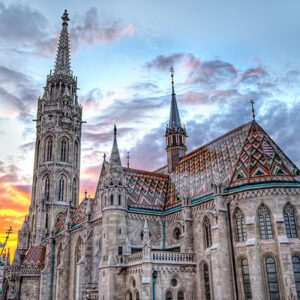
Matthias Church
Matthias Church in Budapest showcases one of the most intricate tile installations in Europe. The original church was built in 1255 but underwent numerous reconstructions over the centuries, serving various religious denominations and even hosting royal coronations.
In 1896, architect Frigyes Schulek added the current diamond-patterned ceramic roof made from colorful Zsolnay tiles, a distinctive Hungarian ceramic known for its brilliant glazes. The roof features bright teal, orange, red, and green tiles arranged in complex patterns including flowers, chevrons, and crosses.
The precision required for installation must have been extraordinary. Each tile fits perfectly into the intricate design, creating a visual masterpiece that complements the church’s restored Gothic architecture and gargoyles.
Shwedagon Pagoda – Myanmar’s Golden Wonder
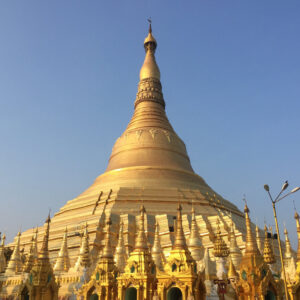
Shwedagon Pagoda
The Shwedagon Pagoda in Yangon, Myanmar, features one of the most opulent roofs in the world. This Buddhist shrine has stood for centuries, prompting visitors to wonder how ancient builders collected such immense wealth.
The traditional layered pagoda roof transitions into a soaring stupa, a tall golden spire that reaches 99 meters into the sky. What makes this structure truly extraordinary is that real gold plates cover its entire length. At the very apex sits a massive diamond, symbolizing enlightenment and spiritual perfection.
According to legend, the stupa guards eight hairs from Buddha’s head along with other sacred relics, though the public cannot enter the main structure. The gleaming golden roof visible for miles has made the Shwedagon Pagoda the most important pilgrimage site in Myanmar and one of the most sacred Buddhist sites in the world.
Notre-Dame Cathedral: Phoenix Rising From the Ashes
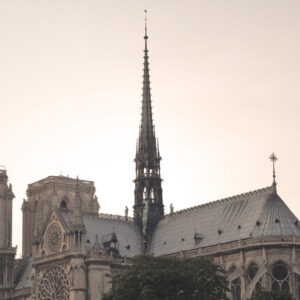
Notre Dame Cathedral
The iconic roof of Notre-Dame Cathedral in Paris represents one of the most ambitious restoration projects in history. The original roof, known as “the forest,” was a vast network of massive oak beams constructed between 1220 and 1240, measuring over 300 feet long and 42 feet wide.
When fire devastated the cathedral on April 15, 2019, the medieval wooden framework and lead roof were almost entirely destroyed, along with the famous spire designed by architect Eugène Viollet-le-Duc in the 1860s.
The restoration required approximately 1,000 oak trees harvested from about 200 French forests, each tree carefully selected to meet precise specifications: 150 to 200 years old, perfectly straight, over 60 feet tall, and 50 centimeters in diameter. Carpenters employed 13th-century traditional techniques, using axes and hand tools rather than power saws to preserve the wood’s natural fiber strength.
The cathedral reopened on December 7, 2024, after involving approximately 2,000 craftspeople, 250 companies, and about $900 million in restoration costs. The rebuilt oak framework and lead roofing of the nave, choir, and reconstructed spire stand as symbols of French heritage and the enduring power of architectural restoration.
Vancouver Convention Center – North America’s Green Giant
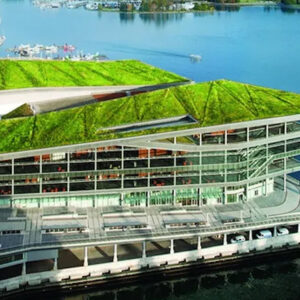
Vancouver Convention Center
The Vancouver Convention Center in Canada boasts the largest non-industrial green roof in North America, spanning six acres and representing a new era of sustainable architecture.
The living roof is planted with over 400,000 native grasses and plants indigenous to Vancouver, creating habitat for local insects, animals, and four European honey bee hives. The vegetation provides exceptional insulation, protecting the building from summer heat while the roots help manage stormwater runoff. The roof captures 100 percent of excess stormwater that falls on it.
The roof features rolling contours with seven raised glass domes below which sit planetariums, aquariums, and research facilities. The design proves that cutting-edge roofs can be both visually stunning and environmentally responsible, earning the Convention Center recognition as the world’s most eco-friendly meeting venue.
The Lasting Impact of Iconic Roofs
These remarkable roofs represent far more than practical shelter. They embody human creativity, cultural identity, engineering brilliance, and artistic vision. From ancient Rome’s concrete dome to modern sustainable green roofs, each structure pushes architectural boundaries and inspires future generations of designers.
Whether you’re an architecture enthusiast planning your next travel adventure, a homeowner seeking inspiration, or simply someone who appreciates human ingenuity, these famous roofs remind us that the space between earth and sky offers endless possibilities for beauty and innovation. They stand as landmarks not just in their cities, but in the story of human achievement itself.
The next time you walk beneath an ordinary roof, look up and imagine what’s possible. After all, every iconic roof in the world started as someone’s ambitious dream, a vision of creating something that would stand the test of time and capture the imagination of millions.


