

More Space, More Light, Less Than You'd Think
Every homeowner eventually hits the point where the house feels too small. The options are familiar: move, build a full addition, or find a smarter middle path. Full additions in Central Illinois typically run $150 to $300 per square foot once you’ve accounted for foundation work, framing, roofing, siding, electrical, and HVAC extension. That’s a significant number, and for many households it puts the project out of reach.
A sunroom gets you to roughly half that cost while creating what tends to become the most-used room in the house. I’ve built a lot of additions across Champaign County over the years, and sunrooms consistently produce the most enthusiastic reactions from homeowners once they’re finished. The combination of natural light, connection to the yard, and the feeling of added space tends to exceed what people expected going in.
This page covers what sunrooms actually cost, what the seasonal options mean practically, what styles suit different homes, and what separates a sunroom that performs well in Illinois winters from one that doesn’t.
What Sunrooms Actually Cost in Central Illinois
Three-season sunrooms run approximately $80 to $120 per square foot. These are unheated spaces with single-glazed or lightly insulated windows, no connection to your home’s HVAC system, and a simpler foundation where an existing patio slab can often serve as the base. They’re comfortable from roughly April through October in Central Illinois, which covers the majority of the outdoor-use season. Typical total project cost runs $10,000 to $30,000 depending on size and finish level.
Four-season sunrooms run approximately $120 to $180 per square foot. These are fully conditioned spaces with double-glazed thermally broken windows, insulated roof systems, and a connection to your home’s heating and cooling. They function as true living space year-round, usable on a January afternoon the same as a July evening. Typical total project cost runs $20,000 to $50,000 depending on size, roof style, and glazing package.
The other variable that affects cost significantly is whether an existing patio slab can be converted to serve as the sunroom floor. When that’s possible, foundation costs drop substantially. When the site requires a new foundation, costs increase. We assess this early in the process and give you an honest picture of what your specific site requires.
Construction timelines are a meaningful advantage compared to traditional additions. Three-season sunrooms typically take two to four weeks to build. Four-season sunrooms take four to eight weeks. Neither requires opening up interior walls or significant disruption to the rest of the house.
Three-Season vs. Four-Season: How to Decide
This is the first question worth settling because it affects every downstream decision about materials, glazing, and HVAC.
A three-season sunroom is the right answer if your primary use is the warm months, if budget is a meaningful constraint, or if you’re converting an existing porch or patio where the slab already exists. The comfort season in Central Illinois genuinely covers most of the year for this use case. The tradeoff is that the space becomes uncomfortable in December through February and requires no HVAC connection, which means it also can’t serve as a home office or guest room year-round.
A four-season sunroom is the right answer if you want the space to function as a true room rather than a seasonal amenity, if you’re replacing an existing room addition, or if the space will serve as a home office, playroom, or guest room that needs to be comfortable regardless of outside temperature. The additional cost is real, but so is the additional utility. A four-season sunroom adds to your home’s conditioned square footage and shows up that way in an appraisal.
One question that sometimes gets overlooked: what will you actually use this room for? A breakfast nook used for morning coffee is a different use case than a home office that needs consistent temperature and lighting all day. Matching the sunroom type to the actual use prevents the common situation where someone builds a three-season room and then finds it unusable for four months of the year during the exact season they most want to be inside looking out at snow.
Sunroom Styles for Central Illinois Homes
Studio Sunrooms
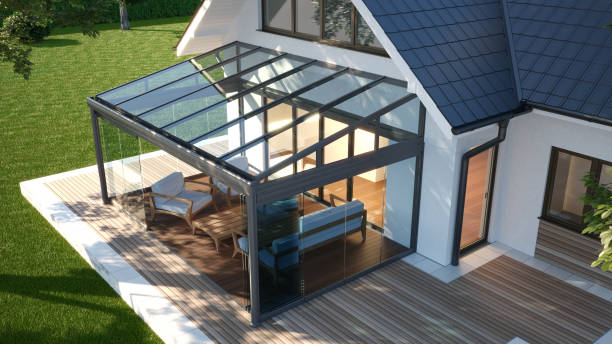
The studio is the most common sunroom style we build, and for most Champaign-area homes it’s the right fit. It uses a single-slope roof that attaches under the existing eave line of the house, keeping the profile low and the visual integration clean. The straightforward geometry means lower cost and faster installation, and the low roofline works well with ranch homes, split-levels, and most contemporary styles.
Studio sunrooms sit in the $10,000 to $25,000 range for typical residential sizes. They look intentional rather than added-on when the roof pitch and exterior materials are matched to the existing house, which is something we pay attention to during the design phase.
Cathedral Sunrooms
Cathedral sunrooms use a peaked roof with a vaulted interior ceiling, which creates significantly more vertical space and natural light than a studio configuration. The effect inside is genuinely dramatic even in a modest footprint. A 12 by 14 foot cathedral sunroom feels larger than a 14 by 16 foot studio sunroom because of what happens overhead.
The peaked roof works best visually when it ties into a gabled roofline on the existing house rather than meeting a flat soffit. Homes with gabled rear elevations are good candidates. Ranch homes with flat eave lines can work but require more careful design attention to avoid the appearance of two competing roof lines.
Cathedral sunrooms typically run $15,000 to $35,000 for standard residential sizes.
Conservatory Sunrooms
Conservatories are the glass house design with curved or faceted roof panels and glass on all sides including overhead. They’re architecturally distinctive in a way the other styles aren’t, and they work best on homes with traditional or Victorian-influenced architecture where the visual weight and formality of the style fits.
They’re less common in Central Illinois for practical reasons. A fully glazed overhead surface in our climate requires thoughtful management of solar gain in summer, and the cost of a properly specified conservatory with insulated glazing and thermal breaks is at the upper end of the sunroom range. When it’s the right fit for the house and the homeowner understands what they’re getting, a conservatory is a genuinely impressive addition. When it’s chosen primarily for visual appeal without considering the climate implications, it becomes an uncomfortably hot room in July and an expensive one to condition in January.
We build them, but we’ll have a direct conversation about whether it’s the right choice before any drawings are started.
Solariums
Roof Systems: The Choice That Affects Everything Else
The roof system on a sunroom is not a cosmetic decision. It determines thermal performance, maintenance requirements, and how comfortable the space is during temperature extremes.
Glass Roof Panels
Full glass roofs create the most dramatic overhead experience and the most direct connection to sky and light. They require insulated glass units with Low-E coatings to be usable in Illinois summers, and even with good glazing the space needs to be managed in peak heat. Automated shades are worth budgeting for on south or west-facing glass roofs. The visual effect is worth it for the right project. The thermal engineering needs to be part of the conversation from the start, not a problem to solve after installation.
Polycarbonate Panels
Multiwall polycarbonate is lighter and lower cost than glass, with good impact resistance and reasonable insulating value. It diffuses light rather than transmitting it clearly, which reduces glare and softens the interior light quality. For large roof areas where glass weight and cost become significant, polycarbonate is a practical choice that performs well in our climate. The visual quality is different from glass, not worse for every application, just different.
Solid Insulated Roof with Skylights
This is the most practical roof choice for four-season sunrooms in Central Illinois. An insulated solid roof panel performs like the rest of your home’s roof, maintaining comfortable interior temperatures without the thermal challenges of full glazing. Skylights placed strategically provide overhead natural light without sacrificing thermal performance. The finished appearance matches a traditional home addition more closely than a glass or polycarbonate roof, which suits some architectural styles better.
For homeowners who prioritize year-round comfort and low energy costs over the dramatic glass ceiling experience, this is almost always the recommendation we make.
Orientation and Placement: This Decision Is Permanent
Where the sunroom goes and which direction it faces determines how the space performs for as long as the house stands. It deserves more thought than it usually gets.
South-facing sunrooms receive maximum light year-round but require the most management in summer. In a four-season room with good Low-E glazing and some shading capacity, south-facing is excellent. In a three-season room with minimal glazing performance, it can become brutally hot by mid-morning in July.
East-facing rooms get morning light and are typically comfortable throughout the day. They're well-suited to breakfast rooms, home offices, and spaces used primarily in the morning. The afternoon sun exposure is limited, which helps with cooling.
West-facing rooms get afternoon and evening light, which works well for rooms used later in the day. The challenge is summer afternoon sun, which is intense and low in the sky. West-facing sunrooms need more shading consideration than east-facing ones.
North-facing rooms receive the most consistent, indirect light with minimal direct sun. They're the coolest and most thermally predictable. The light quality is even and diffused rather than dramatic. North-facing sunrooms are comfortable in summer without much management, which makes them a strong choice when cooling simplicity is a priority.
Before we finalize placement, we walk the site with the homeowner at a few different times of day when possible. Seeing where the shadows fall and where the afternoon sun hits in your specific yard is more useful than any general guidance.
Illinois-Specific Considerations
A sunroom designed for coastal Georgia and a sunroom designed for Central Illinois are not the same project. A few things specific to our climate worth knowing:
Frost depth. Champaign County’s frost line is approximately 36 inches. Any sunroom foundation, whether a perimeter wall, piers, or isolated footings, needs to bear below that line. Sunrooms that use a converted patio slab without perimeter footings below frost depth will move seasonally, which shows up as doors that stick, gaps in weatherstripping, and eventually cracked glazing.
Wind loads. Central Illinois is open terrain with limited windbreaks, and summer storms regularly produce 60 mph gusts. Sunroom framing and glazing need to be engineered for actual local wind conditions, not generic residential assumptions.
Thermal expansion. The temperature swing between a January night and an August afternoon in Champaign can exceed 100 degrees. Aluminum framing systems need thermal breaks to prevent condensation on interior surfaces in winter. Glazing seals need to be specified for wide thermal cycling. These details are in the engineering, not visible in the finished product, but they determine whether the sunroom performs well in year five and year fifteen.
How a Sunroom Compares to a Full Home Addition
If you’re deciding between a sunroom and a conventional home addition, the cost difference is the starting point but not the only factor.
A four-season sunroom adds conditioned square footage to your home at roughly half the cost per square foot of a framed addition. The tradeoff is that a sunroom is defined by its glazing, which means it feels different from a conventional room. It’s brighter, more connected to the outdoors, and thermally more variable even in a well-insulated four-season design. That’s a feature for most homeowners and a drawback for some.
A conventional addition built as a bedroom, family room, or home office reads as undifferentiated living space because it has walls, insulation, and windows in the same proportion as the rest of the house. A sunroom reads as a sunroom, which is what makes it appealing to the people who want one.
If what you need is a bedroom, build a bedroom. If what you want is a bright, plant-filled room where you can feel the seasons from inside a comfortable space, a sunroom delivers that at a cost a conventional addition can’t match.
If you’re still weighing the options, our home additions page covers the full addition landscape including bump-outs, room additions, and second-story additions with cost ranges for each.
Ready to Get Started?
We build sunrooms throughout Champaign, Urbana, Savoy, Mahomet, Rantoul, and the surrounding communities. Contact Roof Panther for a free in-person consultation. We’ll look at your space, talk through the three-season versus four-season decision, and give you an honest assessment of what works for your home and your budget.
Our Credentials

Licensed
In Illinois (#104.018415) and growing

Bonded
For your peace of mind

Insured
With high limits

Guaranteed
With a workmanship warranty
Contact Us! (Please provide your contact information below.)
We Look Forward To Working With You!
Roof Panther
903 N High Cross Rd. Urbana, IL 61802
By Appointment Only
Phone
(217) 530-8570
roofpanther@gmail.com