

The Structure That Makes Your Backyard Worth Using
Most backyards in Champaign get mowed, weeded, and largely ignored. You maintain them out of obligation more than enjoyment, and the reason is usually pretty simple: there’s nowhere comfortable to actually sit. Full sun in July makes the back patio miserable by ten in the morning. An unexpected thunderstorm sends everyone inside. Without some structure overhead, outdoor time in Central Illinois is weather-dependent in a way that makes it more trouble than it’s worth.
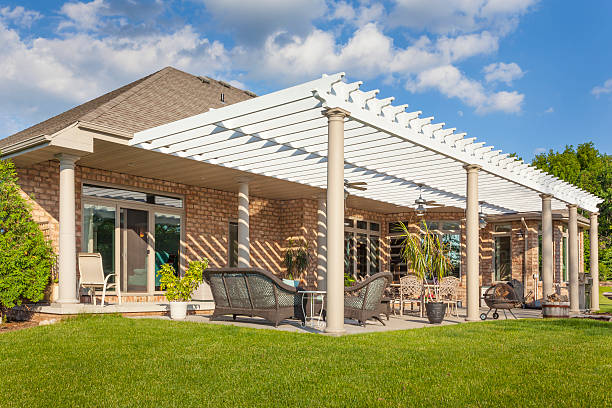
A pergola solves that. Not completely, not the way an enclosed room does, but enough. You get defined shade, a sense of enclosure without walls, and a space that reads as intentional rather than just an open patch of yard. I’ve installed pergolas throughout Champaign County and the surrounding communities, and the consistent thing homeowners tell me is that they start using their backyard in ways they never did before.
What a Pergola Actually Is
It’s worth being clear on this since the term gets used loosely. A pergola is an open overhead structure supported by posts, with a series of beams and rafters or louvers spanning between them. It provides partial or adjustable shade. It does not have solid walls or a fully enclosed roof the way a sunroom or screened porch does.
That openness is what makes pergolas distinct and useful in a specific way. You’re still connected to the outdoors, you still feel the breeze, you still hear the yard. You’re just shaded and defined. A pergola turns an undefined outdoor area into a room that happens to have no walls.
What separates a pergola from a simple patio umbrella or shade sail is permanence and architecture. A well-built pergola is a structural feature of your property. It has footings in the ground, it’s built to withstand Central Illinois wind and weather, and it adds genuine value to the home the way a deck or addition does.
Pergola Types: Attached, Freestanding, and Garden
Attached Pergolas
An attached pergola connects directly to your house on one side, with posts carrying the load on the opposite end. The ledger board fastens to the home’s rim joist or wall framing, and the structure extends outward over a patio, deck, or open yard area.
This is the most popular type we build, and the reason is simple: it feels like an extension of the house rather than a separate structure. Step out the back door and you’re immediately under cover, with a defined space for a table, seating, or an outdoor kitchen setup. The connection to the house also means it’s the most convenient location to run electrical for lighting, ceiling fans, or an outdoor heater.
Attachment details matter here. The ledger board needs to be flashed correctly where it meets the siding or wall cladding, just like a deck ledger. Water infiltration at a poorly flashed ledger connection is one of the more common problems we see on pergolas built by contractors who come from landscaping rather than construction. We’ve fixed enough of them to take this detail seriously.
Freestanding Pergolas
A freestanding pergola stands independent of the house on four or more posts, and can be placed anywhere on the property. Common locations are over a patio away from the house, at the edge of a yard to create a destination point, over a fire pit or seating area, or straddling a garden path.
The main practical difference from an attached pergola is that all four corners carry load equally, which means post sizing and footing depth matter more. A freestanding structure in an open yard also sees more wind exposure than one tucked against a house wall. We account for that in the footing design and post sizing, particularly for larger spans.
Freestanding pergolas give you more placement flexibility and can create a genuinely useful second outdoor zone separate from the main back patio. They’re popular with homeowners who have a larger yard and want to create distinct spaces for different uses.
Garden Pergolas
Garden pergolas are narrower and more linear than the other types, typically designed to span a walkway or create a covered passage through a garden area. They’re specifically built to support climbing plants, with the overhead structure serving as the frame for vines, roses, wisteria, or whatever the homeowner wants to grow up and over.
These take several seasons to reach their full effect as the plantings fill in, but the result is something genuinely distinctive. I’ve built garden pergolas that started as bare cedar posts and within three or four years became tunnels of wisteria that barely showed the structure underneath. The combination of architecture and plant material creates something that neither achieves on its own.
Pergola Materials: Cedar, Aluminum, Composite, and Steel
The material you choose affects appearance, maintenance requirements, longevity, and cost. Here’s an honest breakdown of the options we work with.
Cedar
Western red cedar is the traditional pergola material and still a strong choice. It’s naturally resistant to rot and insects, has good dimensional stability compared to other wood species, and looks exactly how most people picture a pergola. It can be left to weather naturally to a silver-gray, stained to maintain a warm brown tone, or painted to match house trim.
The maintenance commitment is real. A cedar pergola that isn’t stained or sealed every two to three years will weather unevenly and eventually show checking and graying that some homeowners find acceptable and others don’t. If you want it to stay looking fresh, it needs periodic attention. If you’re comfortable with a weathered natural look, the maintenance drops significantly.
Pressure-Treated Lumber
Pressure-treated lumber is the budget-friendly structural option. It’s more rot-resistant than untreated wood, widely available, and lower cost than cedar. The tradeoff is appearance. PT lumber is typically a green-gray color when new and weathers inconsistently. Most homeowners who want the wood look prefer cedar and pay the difference. PT lumber makes more sense for pergola structures that will be fully painted or where budget is the primary constraint.
Aluminum
Powder-coated aluminum pergola systems have become genuinely popular over the past decade, particularly the louvered roof systems where the overhead slats rotate to adjust shade levels or close completely against rain. These are a different category of product from a built-from-lumber pergola: they’re engineered systems with specific spans and load ratings, proprietary brackets and hardware, and factory finishes that hold up well without maintenance.
The practical advantages are significant. No staining, no sealing, no warping, no rot. The louvered roof systems in particular are worth considering for Central Illinois because they give you real weather protection when needed while staying open on good days. They cost more than a wood pergola of comparable size, but the long-term maintenance picture is favorable.
The aesthetic is clean and modern rather than traditional. That fits some homes well and looks out of place on others.
Composite
Composite pergola materials use wood fiber and polymer resin, similar to composite decking, to create a product that looks like wood without the maintenance. Colors are consistent, the material doesn’t rot or splinter, and it holds up well in freeze-thaw conditions. It’s a reasonable middle ground between cedar and aluminum for homeowners who want the wood aesthetic without the staining commitment.
Steel
Steel pergola framing is less common in residential applications but worth knowing about for larger spans or contemporary designs where narrow profiles and maximum strength matter. Powder-coated steel is essentially maintenance-free once installed and can span distances that would require much heavier wood members. It’s at the upper end of cost and requires a contractor comfortable working with metal framing, but for the right project it’s the right material.
Illinois Weather and Pergola Durability
A pergola in Central Illinois needs to hold up against summer storms with 60 mph wind gusts, ice loading in winter, and temperature swings of 100 degrees between seasons. The structural details that address this are mostly invisible once the pergola is finished, but they’re what separates a structure that stays put for 20 years from one that starts racking and leaning within five.
Post footings are the foundation of everything. Posts set directly in soil or in shallow surface-mounted hardware won’t hold up in our frost conditions. We dig below the frost line, which in Champaign County is approximately 36 inches, and pour concrete footings that give the structure a fixed base that doesn’t move with freeze-thaw cycles. Surface-mounted post bases can be appropriate in some applications but require the right hardware and proper installation to provide adequate lateral resistance.
Post sizing and spacing affect both structural performance and appearance. A pergola with undersized posts in relation to its span will deflect visibly under load and won’t carry ice accumulation well. We size posts and beams to the actual span and load conditions, not to the minimum that looks okay on a calm day.
Hardware and connections get weatherproofed where they meet wood. All cut ends of lumber get sealed before assembly. Exposed fasteners are stainless steel or hot-dipped galvanized to prevent rust staining on the wood surface. These details add some cost and time but avoid the rust streaks and joint degradation that show up on pergolas where hardware wasn’t specified for outdoor exposure.
What the Installation Process Looks Like
From the initial consultation to the finished structure, here’s a realistic picture of the timeline and phases.
The planning and design phase typically runs two to four weeks. We assess the site, take measurements, discuss material and style preferences, review shade patterns based on the structure’s orientation, and apply for any required permits. Most pergola installations in Champaign County require a permit, particularly attached structures, since they need to meet setback requirements and sometimes wind load provisions under the local building code.
Foundation and structural work takes two to four days for a typical residential pergola. This covers layout marking, utility location verification before any digging, footing excavation and concrete pour, curing time before setting posts, and beam and rafter installation once the posts are plumb and set.
Finishing work, including any electrical rough-in for lighting or fans, application of stain or sealant if needed, installation of shade elements or louvered systems, and final cleanup, typically takes one to three additional days.
Total elapsed time from first conversation to finished structure is usually four to eight weeks, most of which is planning, permitting, and scheduling rather than active construction.
Pergolas and the Outdoor Living Picture
A pergola works best as part of a considered outdoor space rather than a standalone feature dropped into a yard. The structures that get used most are the ones that connect logically to how the rest of the outdoor space is organized.
An attached pergola over an existing patio is a natural combination: the patio provides the hard surface and the pergola provides the overhead definition that turns it into a room. A freestanding pergola positioned over a fire pit area creates a destination point in a larger yard. A garden pergola as a transition between a patio and a garden area connects different zones of the property with a covered passage.
If you’re also thinking about a deck or patio as part of the same project, it’s worth designing both together. The post footing locations for an attached pergola need to coordinate with the patio or deck layout, and doing that planning once produces a better result than adding the pergola as an afterthought.
Ready to Get Started?
We build pergolas throughout Champaign, Urbana, Savoy, Mahomet, Rantoul, and the surrounding communities. If you have a backyard that isn’t getting used the way you’d like, contact Roof Panther for a free in-person estimate. We’ll look at your space, talk through material and style options, and give you a realistic picture of what the project involves and what it costs.
Our Credentials

Licensed
In Illinois (#104.018415) and growing

Bonded
For your peace of mind

Insured
With high limits

Guaranteed
With a workmanship warranty
Contact Us! (Please provide your contact information below.)
We Look Forward To Working With You!
Roof Panther
903 N High Cross Rd. Urbana, IL 61802
By Appointment Only
Phone
(217) 530-8570
roofpanther@gmail.com